Patella tendinopathy (PT), also referred to as Jumper’s Knee, is a common and severe degenerative knee injury. The injury acquired the name jumper’s knee as it is diagnosed frequently in sports such as Basketball, which involve repetitive jumping and landing movements. Tendinopathy is a general term to describe overuse and can affect most tendons used actively during sports.
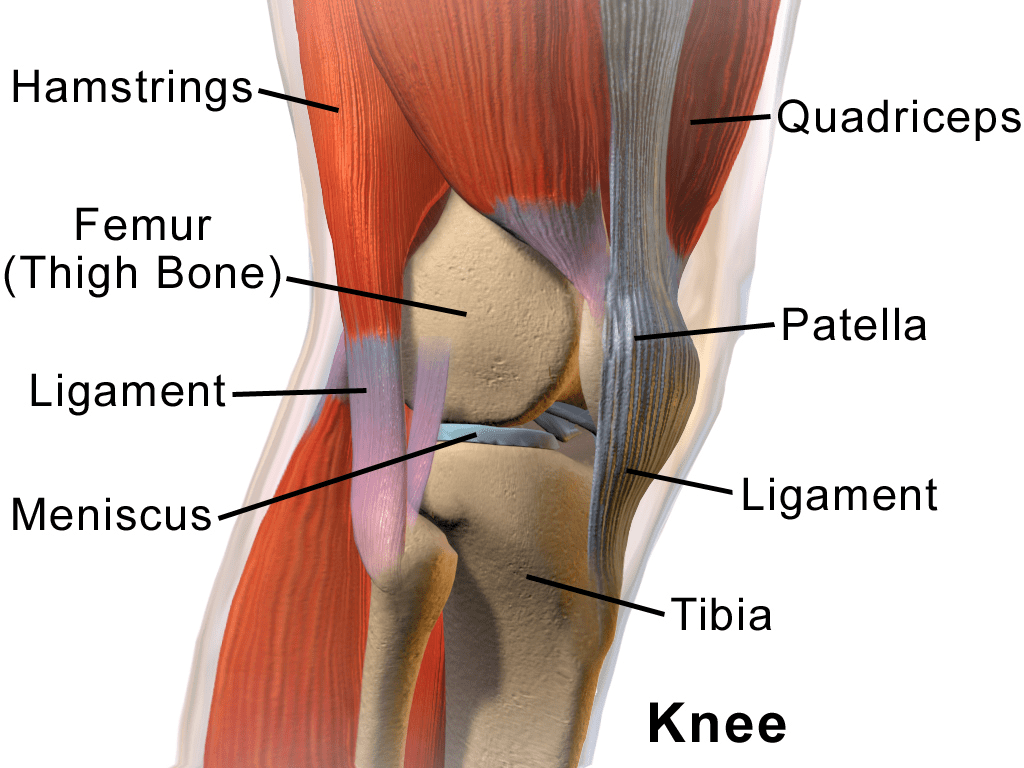
A diagram showing the anatomy of the knee and the location of the Patella Tendon
Retrieved from: https://commons.wikimedia.org/wiki/File:Blausen_0597_KneeAnatomy_Side.png
The patella tendon is a strong tendon that works together with the quadriceps tendon to perform knee extension. It is made up of collagen fibres, which undergo micro tears the same way muscle fibres do. However, tendons do not have the same elasticity as muscles, which means that repeated trauma can cause gradual degeneration of the collagen fibres and change the tendon structure. PT is a result of repetitive loading on the patella tendon.
Research suggests the occurrence of PT in athletes aged 19 to 29 is 32% and is more prone to male athletes who are taller and have a higher body mass. Younger athletes are less likely to develop PT as it is an overuse injury and their level of play will be far less demanding.
Injury Grading
Grade 1 <25% fibres torn
Grade 2 20-50% tendon damage
Grade 3 >50% fibres damaged
Grade 4 Full rupture of the patella tendon
Intrinsic Factors
- Low ankle movement from tight calves
- Previous ankle sprains
- Increased weight and height
- Male gender
- Higher age
The older an athlete, the more time their tendon has been exposed to various strains.
Tight calves and previous ankle sprains together can contribute to reduced ankle ROM; affecting an athletes landing biomechanics
Signs and Symptoms
- Front of the knee pain
- Tenderness
- Warmth
- Redness
- Swelling
- Leg stiffness
- Muscle wastage
- Quadricep weakness
Treatment
Immediate care of any grade of PT should include following the PRICE protocol to bring down any inflammation or swelling.
P: Protection
R: Rest
I: Ice
C: Compression
E: Elevation
A grade four will need medical assistance straight away and require surgical treatment.
If you suspect any injury to soft tissue, it is advisable to visit a medical professional for examination and further tests. Early intervention is important to help preserve an athlete’s career and it is crucial to identify risk factors aiding in the gradual deterioration of the athletes strength and performance.
Yolande Fowler-Wright, BSc (hons) Sports Therapist MSST
References
Backman, L.J. and Danielson, P. (2011) ‘Low range of ankle Dorsiflexion Predisposes for Patellar Tendinopathy in junior elite basketball players: A 1-Year prospective study’, The American Journal of Sports Medicine, 39(12), pp. 2626–2633. doi: 10.1177/0363546511420552.
Brukner, P. and Khan, K.A.A. (2012) Brukner & khan’s clinical sports medicine (Mcgraw medical). 4th edn. United States: McGraw-Hill Book Company Australia.
Gemignani, M., Busoni, F., Tonerini, M. and Scaglione, M. (2008) ‘The patellar tendinopathy in athletes: A sonographic grading correlated to prognosis and therapy’, Emergency Radiology, 15(6), pp. 399–404. doi: 10.1007/s10140-008-0729-y.
Hagglund, M., Zwerver, J. and Ekstrand, J. (2011) ‘Epidemiology of Patellar Tendinopathy in elite male soccer players’, The American Journal of Sports Medicine, 39(9), pp. 1906–1911. doi: 10.1177/0363546511408877.
Lian, O.B. (2005) ‘Prevalence of jumper’s knee among elite athletes from different sports: A cross-sectional study’, American Journal of Sports Medicine, 33(4), pp. 561–567. doi: 10.1177/0363546504270454.
Malliaras, P., Cook, J., Purdam, C. and Rio, E. (2015) ‘Patellar Tendinopathy: Clinical diagnosis, load management, and advice for challenging case presentations’, Journal of Orthopaedic & Sports Physical Therapy, 45(11), pp. 887–898. doi: 10.2519/jospt.2015.5987.
Peers, K.H.E. and Lysens, R.J.J. (2005) ‘Patellar Tendinopathy in athletes’, Sports Medicine, 35(1), pp. 71–87. doi: 10.2165/00007256-200535010-00006.
Rees, J.D., Maffulli, N. and Cook, J. (2009) ‘Management of Tendinopathy’, The American Journal of Sports Medicine, 37(9), pp. 1855–1867. doi: 10.1177/0363546508324283.
Rodriguez-Merchan, E. (2012) ‘The treatment of patellar tendinopathy’, Journal of orthopaedics and traumatology : official journal of the Italian Society of Orthopaedics and Traumatology., 14(2), pp. 77–81.
Sharma, P. (2005) ‘Tendon injury and Tendinopathy: Healing and repair’, The Journal of Bone and Joint Surgery (American), 87(1), p. 187. doi: 10.2106/jbjs.d.01850.
Der Worp, H., van der Does, H., Brink, M., Zwerver, J. and Hijmans, J. (2015) ‘Prospective study of the relation between landing Biomechanics and jumper’s knee’, International Journal of Sports Medicine, 37(03), pp. 245–250. doi: 10.1055/s-0035-1555858.
 YFW Sports Therapy
